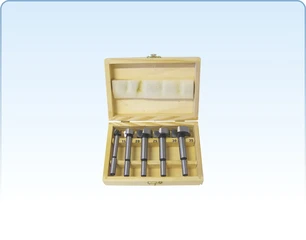
How to choose the right Forstner bit
When choosing a Forstner bit, consider the required hole diameter and depth, the material being drilled, the cutting-edge design and the type of shank.
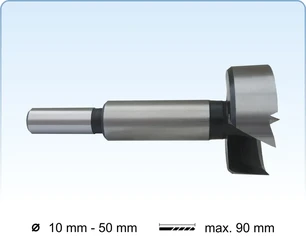
Plain-rim Forstner bits have a smooth, largely continuous cutting rim. This provides good guidance, including when drilling near an edge or making overlapping holes.
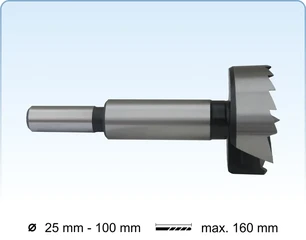
Serrated-rim Forstner bits have individual teeth around the rim. The interrupted contact with the wood can reduce friction and heat, particularly with larger diameters and repeated drilling.
Wave-edge Forstner bits feature a specially shaped outer cutting profile. It helps produce a clean hole edge and may reduce friction and heating. Also consider the required diameter and the specific bit's suitability for the material.
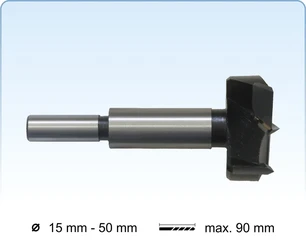
For hardwood or abrasive board materials, machine Forstner bits with carbide cutting edges may be more suitable. Always check the material recommendations for the specific product.
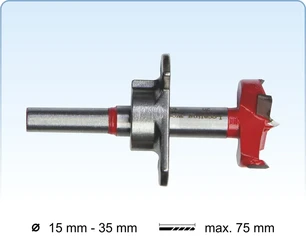
For repeatable blind-hole depths, such as holes for cabinet hinges, a Forstner bit with a depth stop is useful.
For 1/4" tool holders, choose Forstner bits with a hex shank.
Where Forstner bits are used
Forstner bits are mainly used to drill accurate blind holes with a largely flat bottom. Typical applications include furniture, kitchen and door production and general joinery and installation work.
- drilling recesses for concealed cabinet hinges and other fittings,
- recessing fasteners and mounting hardware, including screw and nut heads,
- making accurate pockets and partially overlapping holes,
- drilling near the edge of a wooden part when the tool is properly guided.
The outer cutting rim first scores the wood fibres; the cutting lips then remove material from the bottom of the hole. The centre point may leave a small mark in the bottom.
Forstner bits can also make through-holes, but the exit side must be protected against tear-out. A different drill-bit type is preferable for long, deep holes in structural timber.
How to use Forstner bits
Always drill without hammer action. Secure the workpiece and keep the drill stable. A drill press or other rigid guidance is helpful for accurate, repeated drilling.
Choose the appropriate speed. Follow the bit diameter, wood type and manufacturer's instructions. Larger diameters generally need lower speeds. Excessive feed pressure increases heat and can reduce hole quality.
Clear chips regularly. Withdraw the bit from deeper holes to prevent chip build-up and overheating.
How do you get a clean through-hole? The exit side may splinter when the bit breaks through. Support the workpiece with a sacrificial board. If this is not possible, drill until the centre point marks the opposite face, then finish drilling from that side.
Plain or serrated rim for through-holes? In one practical comparison, the plain rim gave a cleaner entry edge at a faster feed, while the serrated rim gave a cleaner exit edge. At a careful, slower feed the difference was small. For a clean exit, drilling technique and backing support matter more than the rim design alone.
Which types of Forstner bits are available?
The product groups differ mainly in cutting-rim design, depth control and shank type:
- DIN 7483 G plain-rim Forstner bits: a classic continuous rim for accurate blind holes and stable guidance.
- DIN 7483 G serrated-rim Forstner bits: an interrupted cutting rim that can reduce friction and heating, particularly at larger diameters.
- Forstner bits with a 1/4" hex shank: plain-rim and serrated-rim versions for compatible holders.
- Wave-edge Forstner bits with a 1/4" hex shank: a shaped cutting rim for clean scoring of the hole edge with potentially lower friction.
- Carbide-tipped machine Forstner bits: for more demanding materials and frequent work, according to the product's specifications.
- Forstner bits with a depth stop: for controlling hole depth, for example when drilling hinge recesses.
- OREN Forstner bit sets: a selection of diameters for joinery and fitting work.
Show less