How to choose the right SDS-plus drill bit
When choosing an SDS-plus drill bit, first determine what material you will be drilling into and how demanding the work will be. It is not only about the diameter and depth of the hole, but primarily about the design of the drill head – this determines drilling stability, tool lifespan and how the bit handles hard concrete or reinforcement.
2-cutter head SDS-plus drill bits
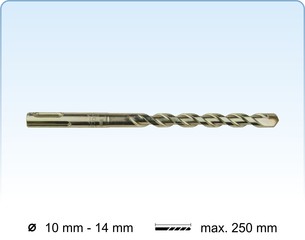
If you are dealing with standard installation work and drilling into masonry or non-reinforced concrete, a two-cutter drill bit is usually the most common choice.
When this is a good choice
- fast penetration in standard masonry and concrete
- suitable for installation and assembly work
- a simple solution for standard use
What to consider
- lower stability in hard concrete
- less capable when encountering reinforcement
- faster wear during demanding work
X-cutter head SDS-plus drill bits
If you want better control over the drill bit and work more frequently in harder concrete, choosing a four-cutter design makes sense.
When they are worth using
- more stable drilling guidance
- more precise holes
- more even load distribution on the drill head
Things to keep in mind
- not as fast in soft masonry
- better suited for regular and more demanding work
SDS-plus Tri-Cut drill bits (solid carbide head)
The most durable option in this category are SDS-plus Tri-Cut drill bits with a solid carbide head. They are designed for situations where maximum reliability is required even under demanding conditions.
When they are the right choice
- drilling into hard and reinforced concrete
- long-term or repetitive use
- minimal risk of damage when contacting reinforcement
Limitations
- often unnecessarily robust for occasional drilling
- their full potential is mainly used in professional applications
Special SDS-plus drill bits for specific situations
Hammer drilling is not always ideal. When working with sensitive or slippery materials, universal SDS-plus drill bits are used, designed for drilling without hammer action – for example into tiles, ceramics, hollow masonry, plastics or panel materials.
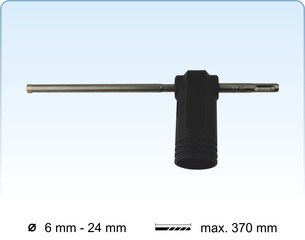
In environments where dust control and clean working conditions are required, SDS-plus suction drills are used. These allow drilling with significantly reduced dust when connected to a vacuum cleaner and are especially suitable for indoor work or repetitive drilling.
In most common applications, the correct drill head design is decisive. Special SDS-plus drill bits are selected when addressing a specific issue – sensitive material, reinforced concrete or the need for a clean working environment.
Where and how SDS-plus drill bits are used in practice
SDS-plus drill bits are mainly used for standard construction, installation and assembly work where drilling into concrete, masonry or stone is required. Typical applications include renovations, installation of technologies, electrical installations, plumbing and heating systems or fastening structures to walls and ceilings.
This is exactly what the SDS-plus system is designed for. It offers a wide range of diameters from approximately 4 mm up to 32 mm and working lengths from short drill bits up to versions with lengths of over one meter. This covers most holes commonly encountered in installation work – from anchor fixings to drilling through thicker structures.
Within this range, the SDS-plus system performs best in practice. It allows precise and smooth drilling without unnecessary effort, even where standard hammer drills reach their limits. With larger drilling volumes or longer work in concrete, the difference becomes apparent very quickly – drilling is more efficient, the tool is less stressed and the work progresses at a much better pace.
SDS-plus rotary hammers are now also widely available for home use and are worth considering when drilling into concrete or masonry repeatedly. However, once you reach larger diameters, very deep holes or drill regularly into hard concrete, the SDS-plus system reaches the limits of its capabilities. In such cases, switching to SDS-max becomes the more suitable option, especially for professional use.
How to work with SDS-plus drill bits
For drilling into concrete with the SDS-plus system, rotary hammers and combination hammers with pneumatic hammer action are used. These tools are specifically designed for this type of work. The pneumatic hammer action enables efficient drilling even in hard concrete, larger diameters and deep holes without excessive stress on the tool or the drill bit.
The following recommendations should be taken into account if you want the work to proceed smoothly, achieve good results and avoid unnecessary damage to the drill bit, machine or accessories.
Drilling procedure recommendations
The role of hammer action
SDS-plus drill bits work with the pneumatic hammer action of the rotary hammer. This hammer action is the key element that allows drilling into concrete. Drilling is driven mainly by the hammer energy, not by pressure applied to the drill bit.
Drill guidance and pressure
The drill bit should work primarily through hammer action and the weight of the machine. Do not apply excessive pressure – too much force slows progress and increases tool wear. Proper technique means holding the machine steadily and allowing the drill bit to advance without overloading.
Pilot drilling for deep and breakthrough holes
For deep holes or when using long drill bits, always pre-drill with a shorter drill bit of the same diameter. Starting directly with a long drill bit leads to poor guidance, vibration and excessive tool stress.
Removal of drilled material
During deep drilling, regularly withdraw the drill bit from the hole. If dust is not removed, the drill bit becomes clogged, friction increases and overheating occurs. This is typical when drilling into floors.
Drilling into reinforced concrete
When encountering reinforcement, do not apply excessive force. Use multi-cutter drill bits or drill bits with a solid carbide head. For these situations, Tri-Cut drill bits or other variants designed for reinforced concrete are recommended.
Basic working rules
- Do not apply excessive pressure – let the hammer action and machine weight do the work.
- For deep holes and breakthroughs, always pre-drill with a shorter drill bit of the same diameter.
- Regularly withdraw the drill bit to prevent clogging with dust.
- When encountering reinforcement, do not overload the tool or drill bit.
- If drilling does not proceed smoothly, consider using a more powerful machine or a more suitable drill bit.
Safety warnings
- Always wear eye protection and hearing protection during prolonged drilling.
- Before drilling into walls or ceilings, check for electrical cables, water pipes or gas lines.
- Hold the machine firmly with both hands, especially when the drill bit engages or contacts reinforcement.
- When drilling overhead or into floors, be cautious of falling material and dust.
- Regularly inspect the drill bit – damaged or heavily worn drill bits increase the risk of injury and machine damage.
Limitations of SDS-plus drilling
SDS-plus drill bits are designed for standard installation and assembly work in concrete and masonry. In practice, they handle common hole diameters and depths used in residential construction very well.
Typically, this includes drilling holes of approximately up to 20–24 mm for anchors, installations, brackets or technical systems. The SDS-plus system also handles deeper holes reaching several tens of centimeters, corresponding to typical wall, ceiling or foundation thicknesses. With high-quality drill bits, SDS-plus can also handle occasional contact with reinforcement, especially when using X-cutter head drill bits or solid carbide head drill bits such as Tri-Cut.
However, the combination of diameter and depth must be considered. The larger the diameter and the longer the hole, the more strain is placed on both the machine and the operator. Such holes can be drilled occasionally with SDS-plus, but at a slower pace and with greater physical effort.
If such drilling becomes frequent – for example during repetitive work or prolonged drilling into hard concrete – the SDS-plus system moves beyond its intended range. In these cases, choosing the more powerful SDS-max system becomes the appropriate solution.
How does the range continue?
The SDS-plus drill bit range is structured according to drill bit design and application:
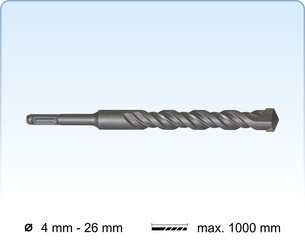
- 2-cutter head SDS-plus drill bits – a basic solution for standard drilling into masonry and concrete during installation work.
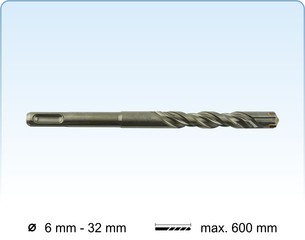
- X-cutter head SDS-plus drill bits – suitable for more precise drilling, better hole stability and longer tool life in hard concrete.
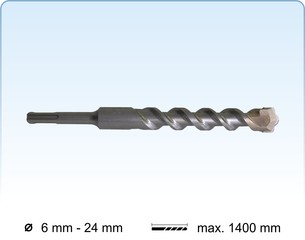
- SDS-plus Tri-Cut PRO drill bits – a specialized design for demanding use, higher drilling speed and efficient work in reinforced concrete.
- Universal SDS-plus drill bits – designed for non-hammer drilling into tiles, ceramics, hollow masonry and plastics. For drywall, they should only be used when drilling through the board and continuing into the masonry behind it. Always without hammer action, with care and control.
- SDS-plus suction drills – a solution for drilling holes with dust extraction, suitable for repetitive work and clean environments.
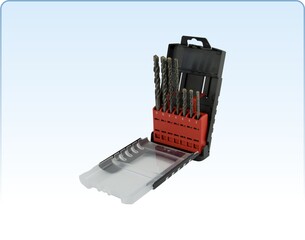
- SDS-plus drill bit sets – a practical choice when multiple diameters are needed for standard construction and installation work.
After selecting the specific type, you only need to choose the required diameter and drill bit length according to your needs.
Hide Description