How to choose a hole saw for drilling tiles and wall cladding
Choosing a hole saw depends on three main parameters: hole diameter, material hardness, and drilling method.
1️⃣ What hole diameter do you need?
We supply diamond hole saws from as small as 5 mm in diameter.
That means even smaller installation holes in tiles and wall cladding can be made directly with a hole saw, especially if a clean edge without chipping the glaze is important.
For larger diameters (pass-throughs for pipes, taps, drains, installation components), hole saws are the standard solution.
However, the decision is not only about hole size, but also about the required cut quality and the sensitivity of the material.
2️⃣ How hard is the material?
The hardness and type of tile strongly affect the tool choice.
Standard ceramic floor and wall tiles
→ can be drilled with diamond hole saws dry or wet.
Very hard porcelain stoneware tiles (gres), porcelain, technical tiles
→ the ideal choice is wet diamond hole saws, which provide a more stable cut, better cooling, and therefore longer life of the diamond segment.
For mobile installation work, dry diamond hole saws can also be used, but you must expect that the tool needs to be cooled regularly.
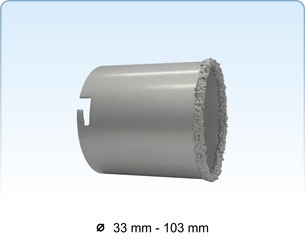
Hole saws with carbide grit
→ in this category they are only available as clearance stock in limited diameters. They are better suited to less demanding applications and standard ceramics.
3️⃣ How will you drill?
All hole saws in this category are intended for drilling without hammer action.
Dry diamond hole saws
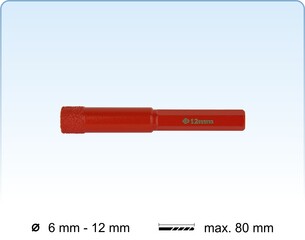
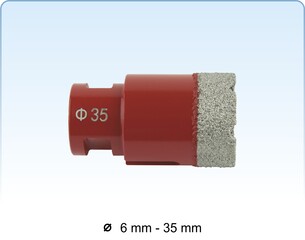
→ ideal for installation work without water supply. There are versions for drills (hex shank) and versions for angle grinders (depending on the clamping type).
Wet diamond hole saws
→ intended for drilling with liquid cooling. Ideal for hard materials, higher precision, and more frequent use.
When choosing, focus on:
- the type of machine you have available,
- cooling possibilities,
- job demands (one-off hole × repeated drilling),
- material hardness.
Where and how tile drilling is used in practice
Drilling into tiles and wall cladding is typically done during finishing and installation work, when the surface is already completed and visible.
Most common situations:
- installing bathroom accessories, holders, grab rails and shelves,
- installing taps and shower systems,
- pass-throughs for water, drains, or electrical installations,
- adjustments in kitchens and utility rooms.
In these cases, drilling control matters more than speed. Damage to a finished tile surface is usually irreversible.
How to work with tile hole saws
Drilling into ceramic materials must always be done without hammer action.
Basic principles:
- work without hammer action,
- use smooth drilling and a moderate feed pressure,
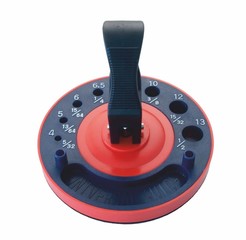
- do not start with the full face – a slight tilt of the hole saw (about 30°) is recommended, then gradually bring it into line,
- with larger diameters, expect tool heating.
Cooling dry diamond hole saws
Even though these hole saws are designed for drilling without water supply, regular cooling must be expected.
You can achieve this mainly by:
- intermittent drilling – after a few seconds, pull the hole saw out and let it cool briefly in the air,
- reducing feed pressure – too much pressure increases friction and segment temperature,
- “cleaning” the segment in a softer abrasive material (e.g., brick) if it becomes glazed,
- for larger diameters, splitting the work into several shorter cycles instead of one continuous cut.
Regular cooling extends the life of the diamond segment and reduces the risk of overheating damage.
Smaller diameters of dry diamond hole saws are filled with cooling wax, which gradually releases during drilling and helps reduce segment temperature. Cooling wax can also be purchased separately if needed.
Wet diamond hole saws
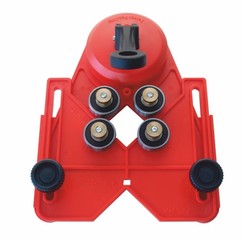
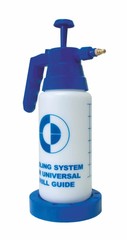
These hole saws are cooled by liquid, which also flushes out the drilled material. This results in a more stable cut, lower temperature, and longer segment life.
Typical risks when drilling tiles:
- cracking the tile when hammer action is used,
- chipping the glaze due to excessive pressure,
- overheating the tool during long uninterrupted drilling,
- the hole saw slipping on a smooth surface without correct hole starting technique.
Hole saws are not intended for deep drilling – their construction is optimized to create a hole of the required diameter within a limited material thickness.
How does the selection continue?
This subcategory is divided by work method and tool design.
Wet diamond hole saws
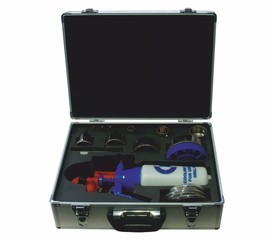
Designed for drilling with liquid cooling, especially in very hard tiles, porcelain stoneware (gres), and porcelain. Suitable for demanding applications and more precise work. They produce a cleaner hole.
Dry diamond hole saws
Designed for installation work without water supply. Versions are available for drills and angle grinders. Suitable for mobile work and for standard to harder ceramics when proper cooling technique is followed.
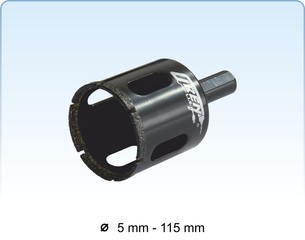
Tungsted carbid holesaw
Clearance stock in limited diameters. Intended mainly for less demanding applications and standard ceramic wall tiles.
Hide Description