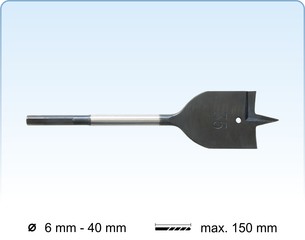
When to choose a flat drill bit
Your choice depends mainly on the required hole diameter and the type of tool.
Do you need to drill a larger hole quickly (e.g., for a cable, conduit, or an anchor)?
A flat drill bit is a good choice for through holes in solid wood, beams, OSB boards, or construction sheet materials.
Are you working with a cordless drill/driver?
Most flat drill bits have a hex shank, which helps prevent slipping in the chuck and is also suitable for cordless drill/drivers. With larger diameters, however, expect higher load on the tool and the need for sufficient torque.
Is the quality of the hole edge important to you?
If you need a clean and precise hole with a smooth perimeter, consider a Forstner bit. A flat drill bit is intended more for fast construction drilling.
Where flat drill bits are used in practice
Flat drill bits are used mainly for construction and installation work.
Typical uses:
- drilling holes for electrical installations (cables, conduits),
- drilling holes for smaller-diameter piping,
- pass-through holes in beams and timbers,
- installation work on construction sites,
- fast drilling of larger diameters without a requirement for a perfect finish.
Their main advantages are speed and simplicity.
How to work with flat drill bits
Use flat drill bits without hammer mode.
Choose the right speed
With larger diameters, start at lower RPM and adjust slightly depending on how the bit behaves. Smaller diameters can handle higher RPM.
Too high RPM is indicated by overheating and darkening of the wood.
Too low RPM shows as uneven cutting and snagging, so you need to push harder for the bit to keep cutting.
The correct setting is when the bit removes material smoothly without strong vibrations.
Keep the tool stable
When drilling larger diameters, the bit can suddenly bind in the material. In that moment, the machine transfers a sharp torque into the operator’s hands and the drill can jerk or twist noticeably.
Hold the drill or cordless driver firmly with both hands and keep a stable stance, especially with larger diameters.
Watch the exit side of the hole
When drilling through, the exit side may tear out. If appearance matters, finish drilling from the opposite side using the pilot point as a guide, or support the underside with a scrap piece of wood to reduce tear-out.
Limitations and what to watch out for
Flat drill bits are not suitable for precise blind holes with a flat bottom.
They are not intended for deep drilling in thick structural elements – in that case, an auger bit is more suitable.
Hide Description